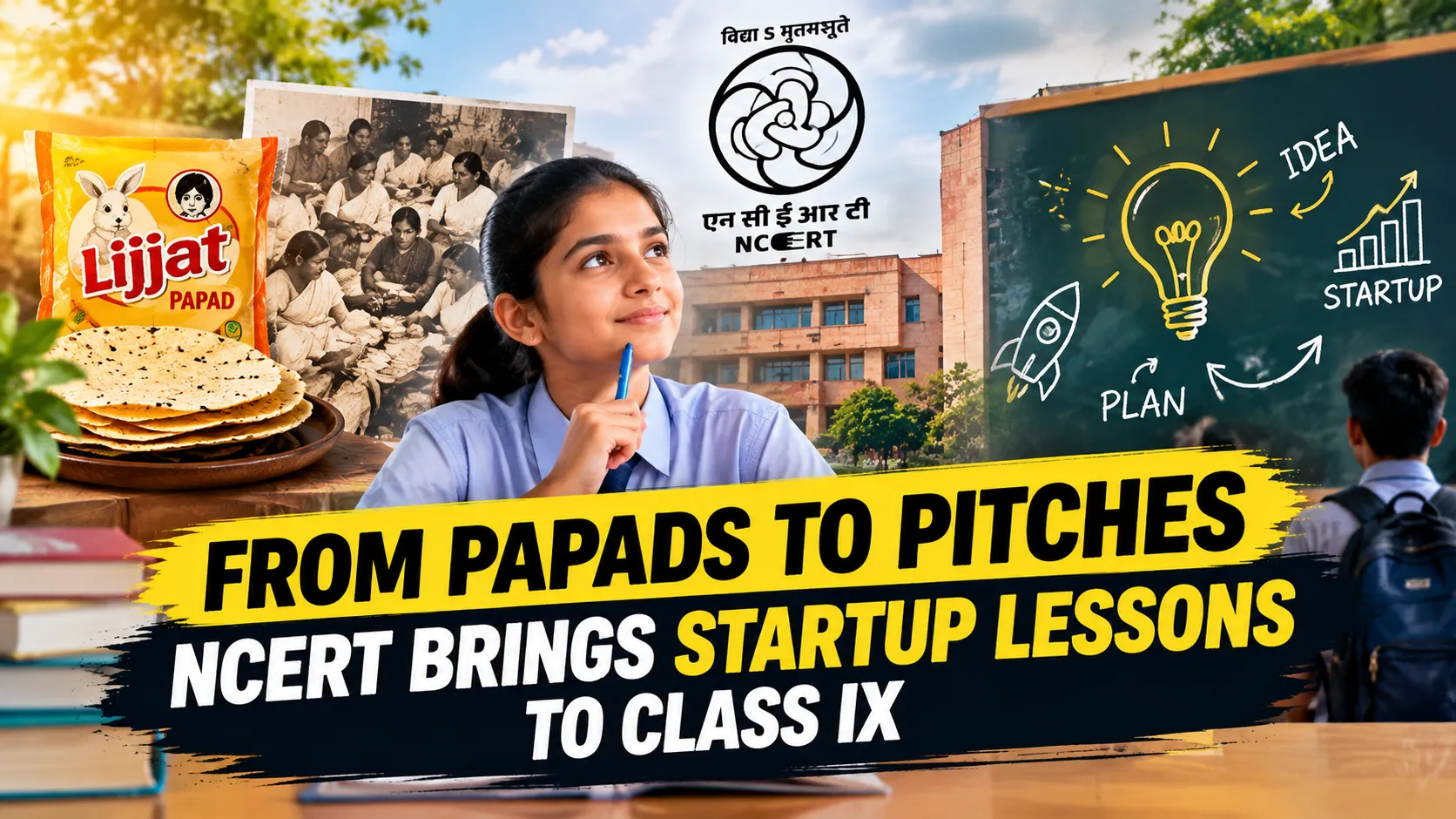
The National Council of Educational Research and Training (NCERT) has introduced a new chapter on startups and entrepreneurship for Class IX students. The new lesson aims to give school students a simple understanding of how businesses are started, how ideas become opportunities and how entrepreneurs can contribute to society and the economy.
The chapter uses real life Indian business stories to make entrepreneurship easier for young students to understand. One of the main examples is Lijjat Papad, which started in 1959 when seven women began making papads with only Rs 80 in borrowed money on a Mumbai terrace. The story explains how a small idea, good quality and teamwork helped the business grow into a well known brand.
Students will also learn about important parts of running a business, including understanding the market, identifying opportunities, checking business performance and preparing a practical business plan. The chapter also explains how different business functions work together. Another example featured in the textbook is Mohan Singh Oberoi, who started his working life with a salary of Rs 50 and later became an important name in India hospitality industry.
The chapter also introduces students to the role of artificial intelligence in business, including its use in market analysis and decision making. NCERT says India startup ecosystem has grown significantly, making entrepreneurship an increasingly important part of the country economy.