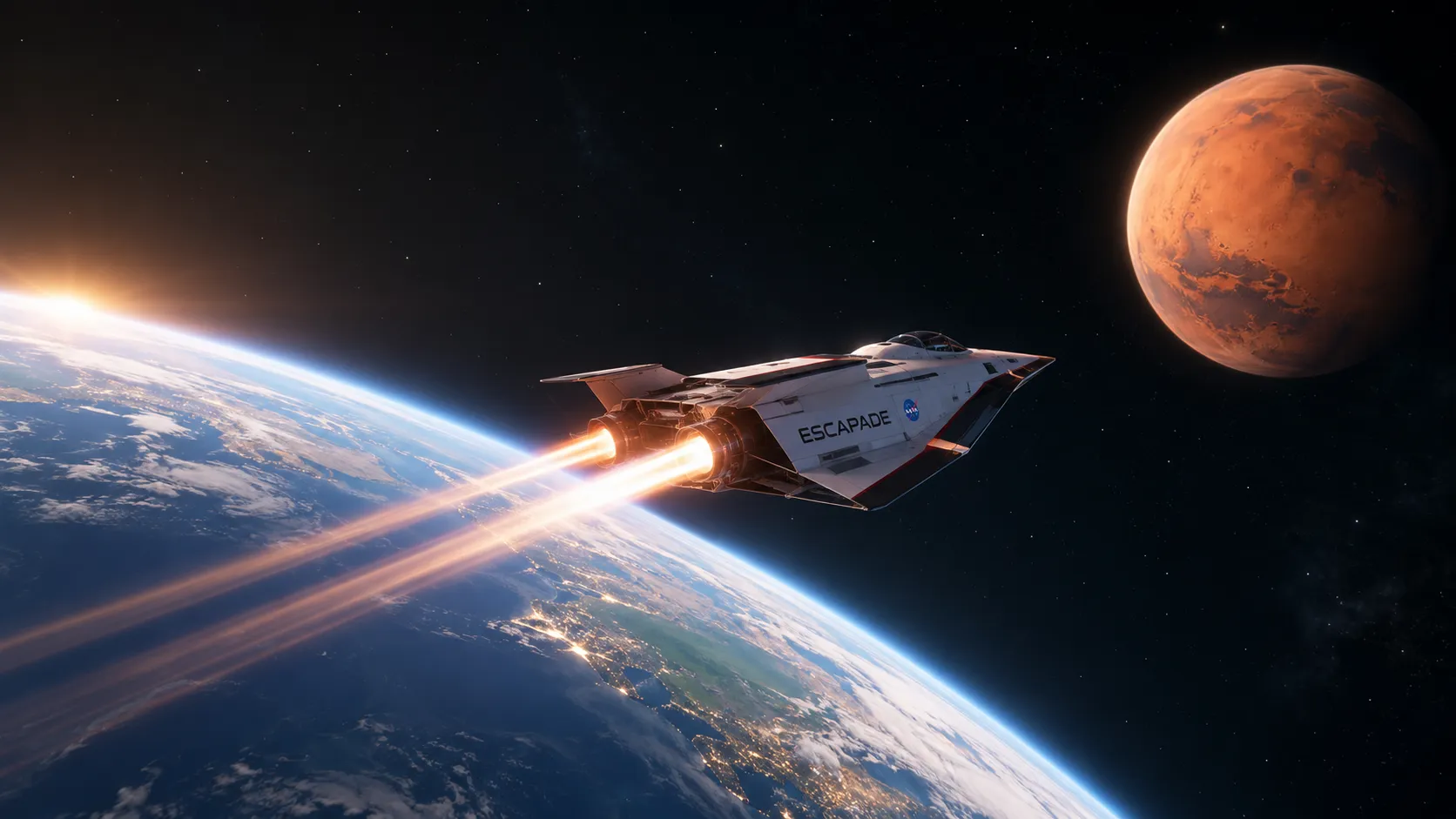
Launched in November 2025 aboard a Blue Origin New Glenn rocket, NASA twin ESCAPADE spacecraft, nicknamed Blue and Gold, spent a year parked near the L2 Lagrange point before looping back to Earth on November 7 and 9, 2026. Combining Earth gravity with a 9 minute engine burn, they pulled off a dramatic slingshot toward Mars, with Gold snapping a parting view of Earth Western Hemisphere and thermal infrared maps from 62,000 kilometres away.
Now on a 10 month cruise to reach Mars in September 2027, the under 80 million dollar mission led by UC Berkeley will fly both probes in formation around the Red Planet. Measuring magnetic fields and solar wind from two spots at once, Blue and Gold will show how space weather stripped away Mars thick ancient atmosphere, turning a warm, wet world into today cold, dry desert.
Now on a 10 month cruise to reach Mars in September 2027, the under 80 million dollar mission led by UC Berkeley will fly both probes in formation around the Red Planet. Measuring magnetic fields and solar wind from two spots at once, Blue and Gold will show how space weather stripped away Mars thick ancient atmosphere, turning a warm, wet world into today's cold, dry desert.